{{ 'fb_in_app_browser_popup.desc' | translate }} {{ 'fb_in_app_browser_popup.copy_link' | translate }}
{{ 'in_app_browser_popup.desc' | translate }}
“A diamond, without proper light, cannot reveal its petal‑like facets—nor its true value.”
— Mr. Pi‑Heh Chen and Mr. Chien‑Tsung Huang, General Manager & Vice GM, Tong‑Hsing Hsieh‑Chi Co.
“Seeing the mountain as a mountain, then not as a mountain, yet still a mountain.” — Master Qingyuan Weixin, Tang Dynasty; a timeless philosophical metaphor that resonates through generations.
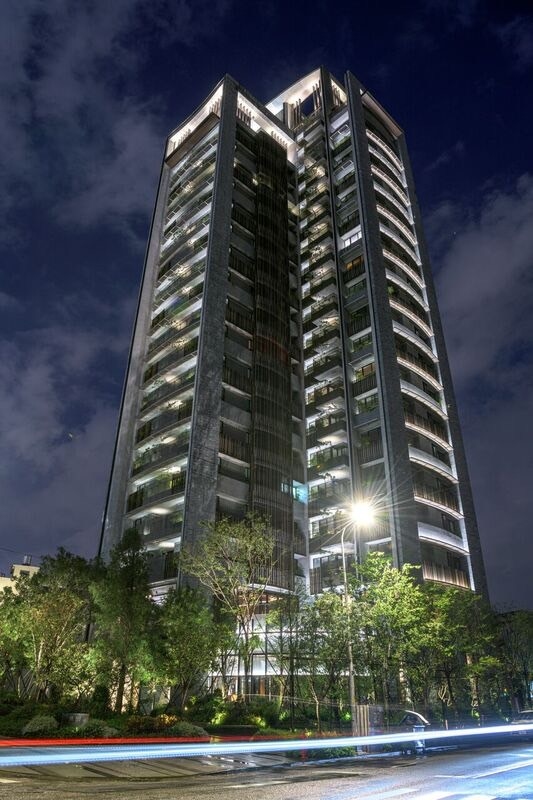
Mr. Pi‑Heh Chen, General Manager of Tong‑Hsing Hsieh‑Chi, envisioned this project seven years ago with one specific visual in mind—for people to behold the building from near and far and feel its presence: “I want people to see a mountain—sublime, yet not oppressive; striking, yet without sharp cliffs.”
In Taiwan, where mountains cover about 70% of the land, they are both the cradle of life and part of everyday reality. In Mr. Chen’s mind, this “mountain” should be both a mountain and not a mountain.
“Visually, I didn’t want to replicate existing architectural forms. It must be the child of Tong‑Hsing Hsieh‑Chi, a timeless signature. Yet it shouldn't rely on flamboyant or bizarre shapes. It’s a residence—its beauty should emerge through detail.” And to make people “see the mountain,” light is indispensable.
“I’ve realized that even the finest materials are wasted without proper light. Like a diamond without the right light—you can’t perceive its petal‑like facets nor its value.” Thus, for the “Seeing the Mountain” project, Mr. Chen devoted great thought to ensuring “perfect light.”
Needless to say, natural light is the ultimate visual standard. Designed in a “品” shape, the building ensures that all indoor spaces receive the sun and moon’s blessings. “Light is a necessity in life—not optional. Many call us foolish, but we know this is right.”
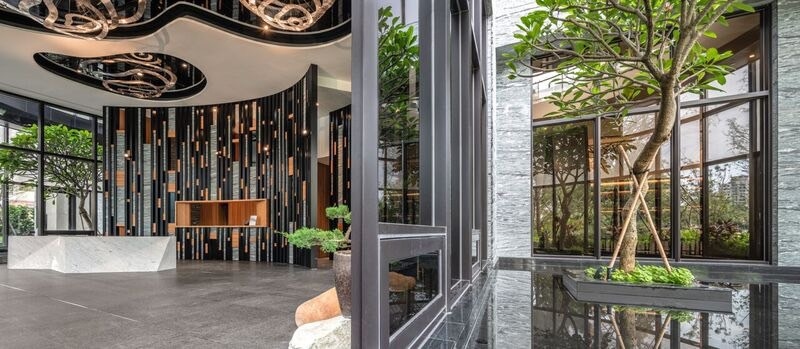
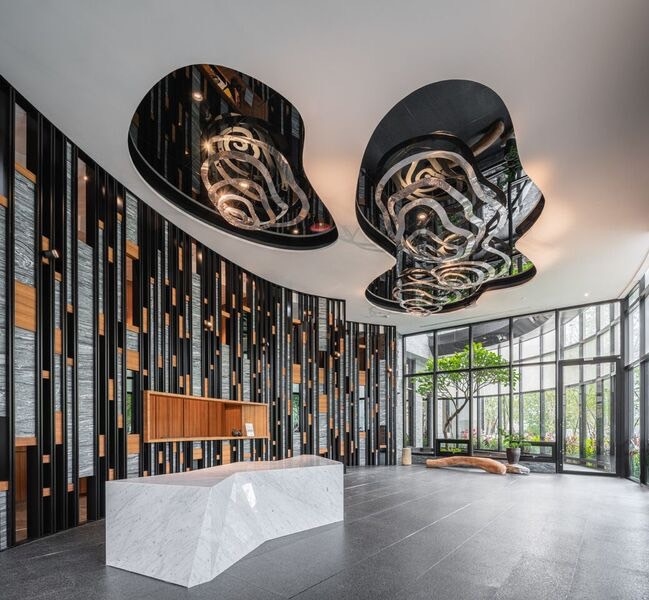
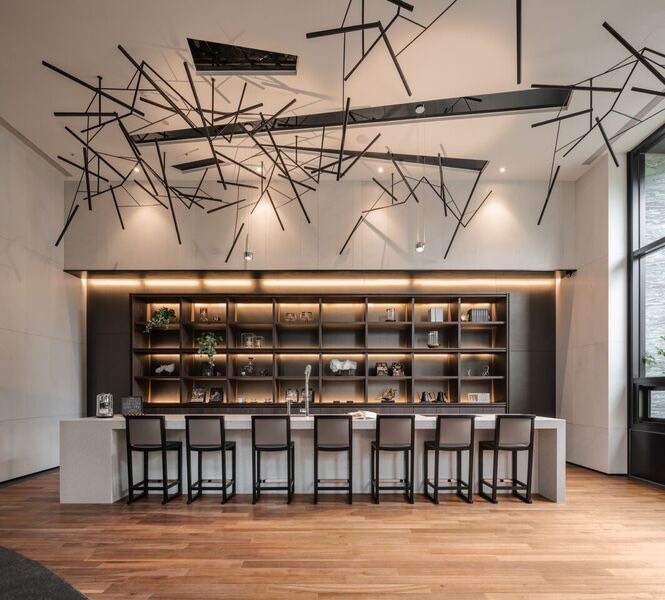
Likewise, high‑quality artificial lighting is also “the right thing.” “Every element in a mountain exists in harmony and nature. That’s why the grand hall has no central fixture, but rather an art piece”—a steel sculpture resembling clouds or contour lines greets guests instead of a traditional light fixture.
“Occhio’s light is not just rich and natural—the fixtures’ restrained, minimalist appearance also helps shape the space’s atmosphere.” The classic Più recessed lights cast a gentle, flowing glow from the ceiling, animating the hand‑engraved cloud patterns with perfect illumination.
On the large mixed‑material wall behind the reception, lui wall lights are discreetly integrated into the colors and lines of the wall. “With mountain, with cloud—and thus with rain. This wall conveys not only the imagery of falling rain but also our relentless pursuit of detail and fearless craftsmanship.”
Walking through the passage framed by this “rain imagery,” the gently curved path resembles a mountain trail—inviting you to slow down and move toward the lounge and banquet area. Yet even here, there’s no central light fixture. Light emerges instead through ceiling gaps shaped like driftwood or bamboo fragments.
“When light enters the mountain, we see tree shadows—not just on floors or walls, but above us as well.” Vice GM Chien‑Tsung Huang points to the up/down lighting of the Sento pendant, casting tree‑like silhouettes on the ceiling—turning light and shadow into art and language. “Without proper lighting, even the best materials fall flat.”
As an operator, Mr. Chen was candid about why they chose Occhio: brand trust was pivotal. “If a chair breaks, people might not notice. If a coffee machine fails, you can replace it quickly. But if a light flickers 7 meters above, everyone sees it.”
Residents’ experience is tied to brand reputation. A malfunctioning high‑placement lamp signals dissent, inconvenience, and high replacement costs.
“We trust German craftsmanship, and we know Occhio and their local partner, Cheng‑Yi International, will support us generously from design to after‑sales. Though initial cost is higher, from a risk‑management perspective, Occhio’s quality ensures residents’ peace of mind and frees the developer from future worries. What could be more important than that?”
Breaking from the common penchant for overly bright luxury lighting, Seeing the Mountain allows light to emerge subtly from within—highlighting textures, structures, and bestowing the architecture with a tranquil depth.
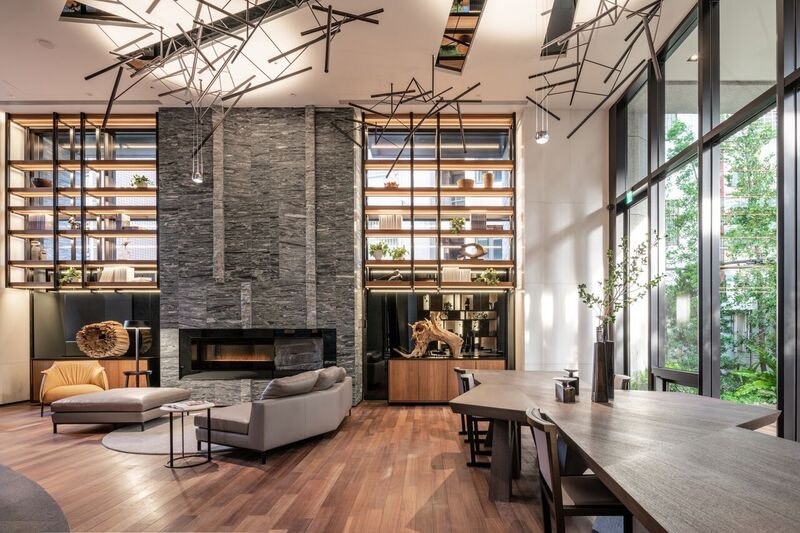
In the grand hall, natural and artificial light converge, yet no fixtures are visible. The ceiling’s cloud sculpture and the wall’s rain motif retain their pure beauty, harmonizing with the outdoor sky and greenery.
Mr. Huang emphasized that ceiling aesthetics are critical. If hanging fixtures expose bold wiring, they blemish details. That’s why the Sento pendants use three slim steel cables that seamlessly merge into the design.
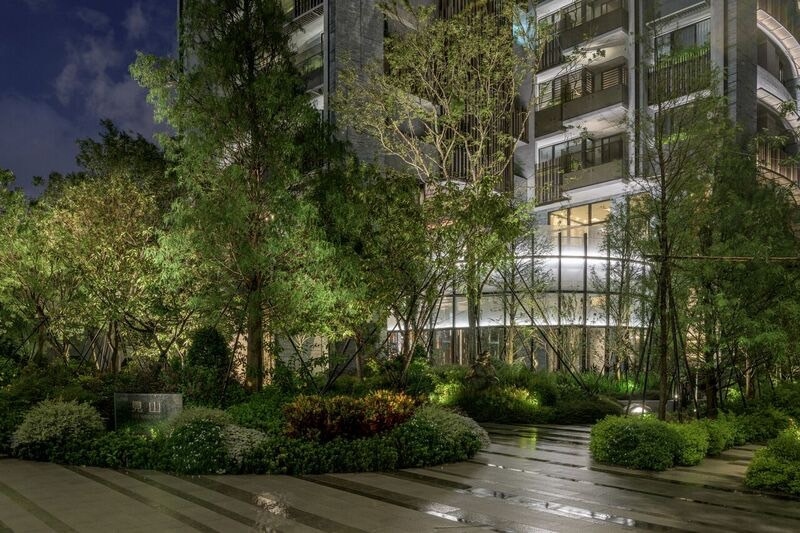
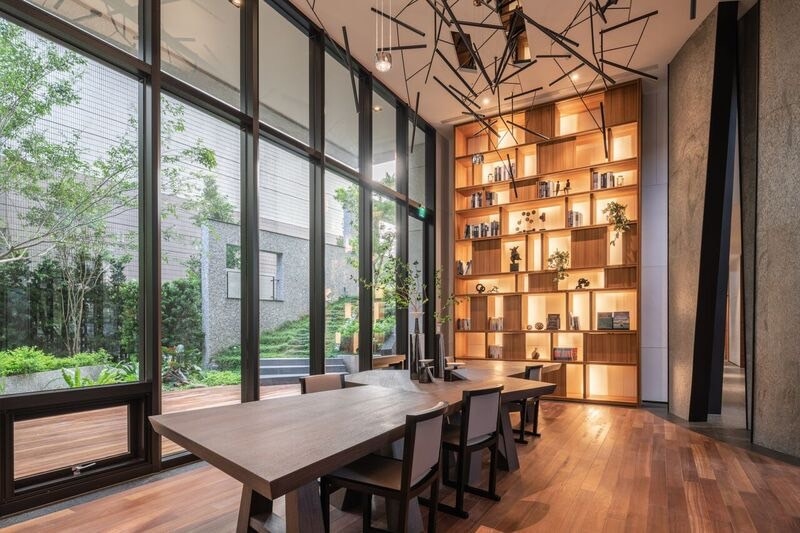
Outside the luminous floor‑to‑ceiling windows, scattering greenery flows along a man‑made knoll—the urban environment meets nature’s whimsy. Inside, a ceiling installation resembling bamboo or branches offers another refined perspective on nature.
In the mountain lives the forest—here, abstracted lines become a lyrical depiction of nature. Through the up/down lighting of Sento, tree shadows are inked across the ceiling, like an immersive brush painting.
Indoors, walls crafted of detailed combinations of stone, wood, and steel evoke rainfall—capturing the dynamic cycle between nature and human touch. As you step outside, the path transitions between form and void, guiding you toward real water, greenery, and a breeze.
Mr. Chen explained: “A mountain never shines with overt brightness—so the lighting here should be understated and inward, like a campfire glimpsed in a forest: subtle, winding, but warm.”